On this page9 sections
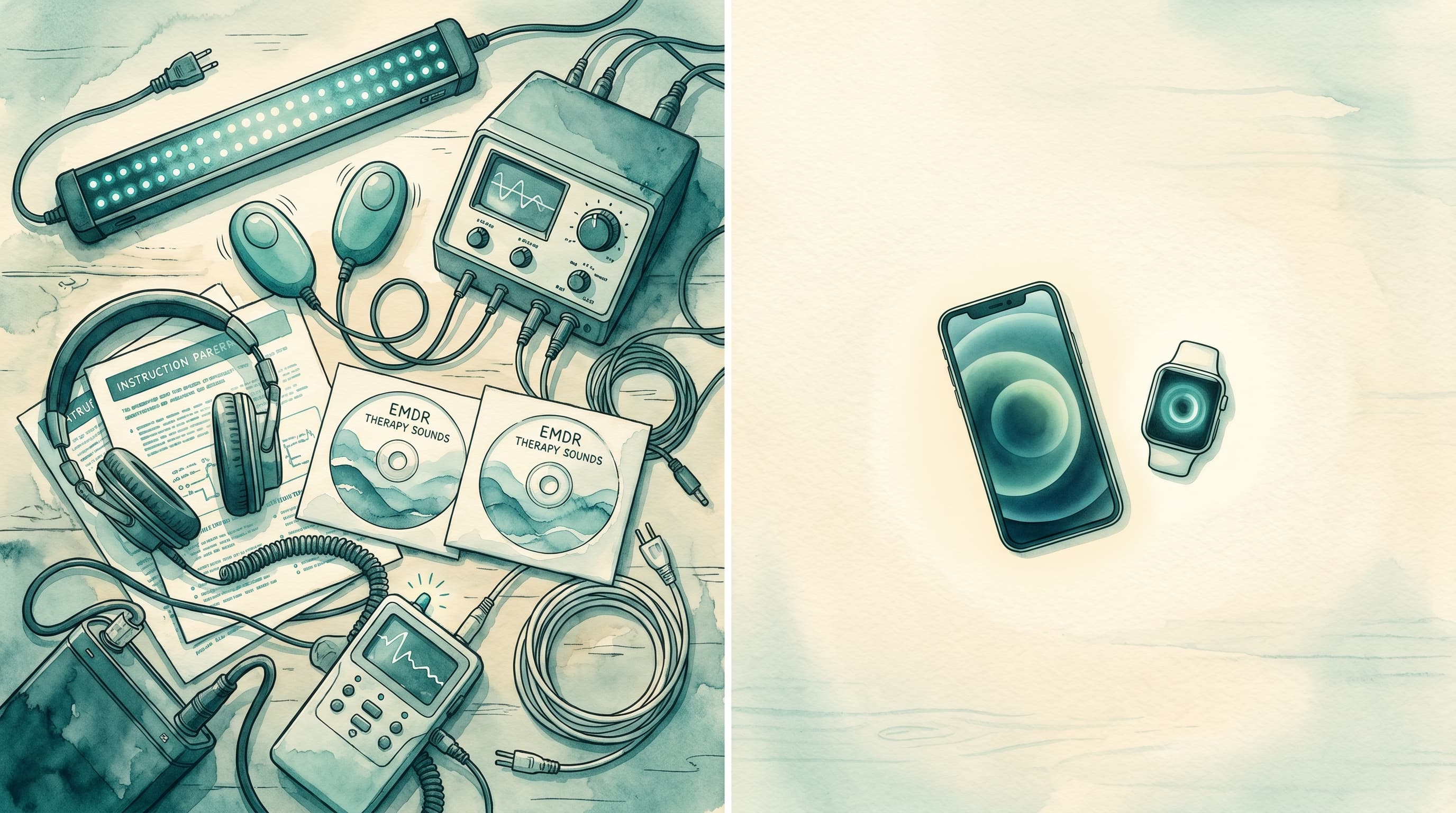
Physical bilateral stimulation equipment has been the standard in EMDR therapy since not long after the protocol itself was developed in the late 1980s. The most common devices are handheld pulsers, light bars, and wearable tapping devices that sit on hands, knees, or shoulders.
These tools have served therapists and clients well for over three decades. But technology has advanced. Software-based BLS can now deliver the same alternating sensory input on devices people already own, with more modalities, more flexibility, and often at a fraction of the cost.
This article compares the two approaches honestly, whether you're a therapist choosing tools for your practice or someone using BLS for self-regulation at home.
What physical BLS equipment looks like
The three main categories of dedicated BLS hardware:
- Handheld pulsers: Two small devices the client holds, one in each hand. They vibrate alternately at speeds the therapist sets. Some are wired to a controller; newer models are wireless. Typical price: $200–$500.
- Light bars: A horizontal bar mounted on a stand or attached to a screen, with LEDs that move back and forth at adjustable speeds. The client follows the moving light with their eyes while keeping their head still. These were the first commercial BLS devices designed specifically for EMDR. Typical price: $400–$800.
- Tapping devices: Wearable or handheld units placed on the body (hands, knees, or shoulders) that vibrate alternately. Some integrate with audio for combined modalities. Typical price: $129–$300.
These tools work well in-office, and many therapists have built their practice around them. They're tangible, don't depend on an internet connection, and have a long clinical track record. They also have real limits: each device is a separate purchase, hardware can break, batteries can die, most cover only one modality at a time, and physical equipment cannot be used for telehealth without shipping it to the client. Digital alternatives address several of these constraints.
What digital BLS looks like
Digital BLS platforms deliver bilateral stimulation through screens, speakers, and haptic motors built into devices people already own. The three modalities map to:
- Visual BLS: An animated dot or bar moving back and forth on a phone, tablet, or computer screen
- Audio BLS: Alternating tones delivered through headphones
- Haptic BLS: Vibration patterns delivered through a phone or, on some platforms, a smartwatch
In a therapist-led session, the therapist controls the parameters (speed, intensity, modality) from their own device, and the client receives BLS on theirs, in real time. The same modalities are also available for solo use, with the user setting their own pace.
EMDR Tappers offers all three modalities and is one of the few platforms that delivers tactile BLS through a phone or Apple Watch rather than requiring separate hardware.
Side-by-side comparison
| Factor | Physical Equipment | EMDR Tappers |
|---|---|---|
| Cost | $129–$800 per device | Free core features |
| BLS types | Usually 1 (tactile or visual) | Visual, audio, and haptic |
| Telehealth | Not possible | Built for remote sessions |
| Device sync | N/A (standalone) | Real-time therapist-client sync |
| Apple Watch | No | Yes, native haptics |
| Client setup | Hand devices to client | Share a link; clients join in the browser on desktop (no install) or install the mobile app |
| Internet required | No | Yes |
| Battery concerns | Yes (device batteries) | Uses client's existing device |
| Durability | Can break, wires fray | Software, no physical wear |
When physical equipment makes more sense
There are still situations where dedicated hardware can be the right choice:
- You've already invested in physical equipment and want to keep using what you have
- The feel of a specific dedicated device matters for you or for someone you work with
- You don't have reliable internet at the location where you'd run BLS sessions
- If you're a therapist, your clinical workflow uses the physical handoff to a client as part of the session ritual, and you don't want to change that
These are honest cases. They tend to be the exception rather than the rule, both for modern practices and for self-regulation use, but the choice between physical and digital is a real one.
When a digital platform makes more sense
A digital BLS platform tends to be the stronger option when:
- You want to reduce or eliminate hardware costs, whether you're outfitting multiple offices, replacing aging equipment, or just exploring BLS for personal use
- You want flexibility across modalities: visual, audio, and haptic BLS in one tool, adjustable in real time
- You want the same tool to work across contexts: in-session use, between-session practice, and solo regulation, without buying separate equipment for each
- If you're a therapist, you offer telehealth and need bilateral stimulation that works remotely without shipping hardware to clients
- If you're a therapist, you need HIPAA-compliant infrastructure with encrypted sessions and no physical devices to track or secure
Can you use both?
Yes. The two approaches mix well. If you're a therapist, a common setup is physical equipment in-office and a digital platform for telehealth. If you're using BLS for self-regulation, you might keep a physical pulser at home for some sessions and use a phone-based tool when you want portability. Neither is required, and both are reasonable depending on how you work.
If you're currently using physical BLS and want to try a digital approach, EMDR Tappers lets you experiment without any cost: visual, audio, and tactile bilateral stimulation are all available in the free tier, with no hardware to buy.
Switching from physical to digital: what to expect
For therapists considering a switch, the lift is smaller than it might seem. Your clinical protocol does not change. The eight phases, the target selection, the processing sets, the check-ins all stay the same. What changes is the delivery of the bilateral stimulation itself.
A few practical notes on what to expect:
- Try it free before committing. EMDR Tappers has a real free tier, so you can run full sessions without subscribing and decide from experience rather than from specs.
- Pacing feels different at first. Digital platforms often give you more granular control over speed, intensity, and tone. The first few sessions are usually about calibrating those settings to each client.
- You can keep physical equipment as a backup. Running a digital platform for telehealth and physical pulsers in-office is a workable combined setup. In-office, you can also use the client's own phone or Apple Watch as the BLS device, or keep a spare phone or watch on hand for clients who don't have one with them. Two phones are usually easier to source on short notice than a dedicated EMDR pulser, and digital devices stay in sync where two independent hardware units sometimes don't.
- Client onboarding is simpler. Instead of mailing a device or explaining hardware, you share a link. Clients join in the browser on desktop or open the app on mobile.
- Tactile fidelity is usually less of an issue than expected. Phone vibration motors and Apple Watch haptics have improved significantly in the last several years. Most clients adapt within the first session, and many report the wrist haptics feel more discreet and less intrusive than handheld pulsers.
- Most clients are comfortable with the technology. People use their phones for many things every day, so a phone-delivered session is familiar territory. The in-session interface is intentionally minimal, and the friction is usually lower than therapists anticipate.
The telehealth factor
This is where the comparison is most clear-cut. Physical BLS equipment does not work for telehealth. If your client is at home on a video call, you cannot hand them pulsers through the screen.
Telehealth is no longer a niche. An APA survey early in the pandemic found 76% of psychologists were working fully remotely, with another 16% mixing remote and in-person care, and telehealth has stayed common since. EMDR works in that setting too. A 2023 review that pooled 16 studies of remote EMDR (1,231 people) found it to be a practical option with promising results, and one study saw no real difference in PTSD outcomes between online and in-person sessions.
Before digital BLS platforms, therapists had to:
- Ship physical devices to clients (expensive, logistically difficult)
- Ask clients to tap their own knees alternately (inconsistent)
- Use screen-share to show a visual BLS animation (one-way, no haptic option)
With digital BLS, you create a session, share a link, and your client receives bilateral stimulation on their own device, controlled by you in real time. This is the primary advantage of a digital platform over physical equipment for any session that isn't in the same room.
Frequently asked questions
Is digital BLS as effective as physical BLS?
Research on EMDR therapy supports all three forms of bilateral stimulation: visual, audio, and tactile. What seems to matter is the steady back-and-forth input and the attention it takes up, not the device that makes it. Studies that compare different forms, such as eye movements versus listening tasks, find similar results. A handheld pulser and a phone's vibration deliver the same kind of alternating input. Effectiveness comes from the therapy as a whole, not the delivery hardware.
Can digital and physical BLS be combined in a single session?
Yes. A common combination is physical pulsers for tactile alongside a digital tool for the visual or audio component. From the client's nervous system perspective, what matters is the alternation, not whether each modality comes from dedicated hardware or a digital device.
How do digital and physical BLS compare on privacy?
Physical equipment is inherently offline. Nothing leaves the room, which is straightforward from a privacy standpoint. Digital platforms transmit session data over the internet, so privacy guarantees depend on the platform's design. Reputable digital BLS tools use encrypted connections; some are explicitly HIPAA-compliant and offer Business Associate Agreements for therapist accounts. Before using any digital tool with clinical clients, check the vendor's current privacy and compliance documentation.
Can speed and intensity be customized as precisely as with physical equipment?
Yes, and often more granularly. Digital platforms typically expose continuous control over speed, intensity, tone, and modality, with adjustments possible during a session without interrupting it.
Will clients adapt to receiving BLS through a phone or smartwatch?
Most people use their phone for many things every day, so a phone-delivered BLS session is familiar territory. Setup on most platforms is intentionally minimal: a single link to join, then a clean session screen. Clients who have used both physical pulsers and phone or Apple Watch haptics often report no meaningful difference in how the BLS feels, and some prefer the wrist haptics for being less intrusive.
This article is for educational purposes. It is not medical advice. Clinical decisions about EMDR therapy and bilateral stimulation tools should be made by licensed therapists in the context of their practice.